
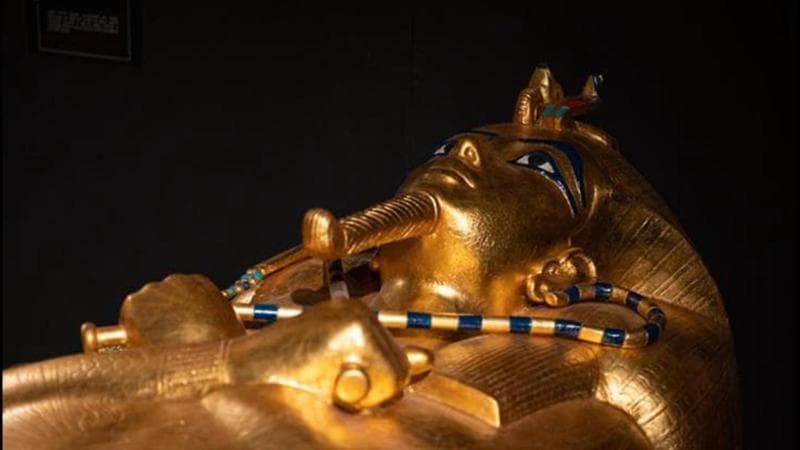
Imagine the thrill of stepping inside the tomb of Tutankhamun, whose funerary mask has become one of the defining images of the pharaohs of Ancient Egypt.
That is the promise of an exhibition at Palazzo Belloni, at 13 Via de’ Gombruti in Bologna, organised by Spazio Mostre for Storica Lab and entitled Tutankhamun: the tomb, the treasure, the curse.
A journey through Ancient Egypt
The exhibition offers an immersive experience combining spectacular sets, architectural reconstructions and virtual imagery with a collection of faithful replicas of objects found in the burial place of the “boy king”.
This is therefore not an exhibition of archaeological artefacts, but an experience designed for adults and children alike, taking visitors back in time to discover the cult of the pharaohs and the burial rituals of Ancient Egypt.
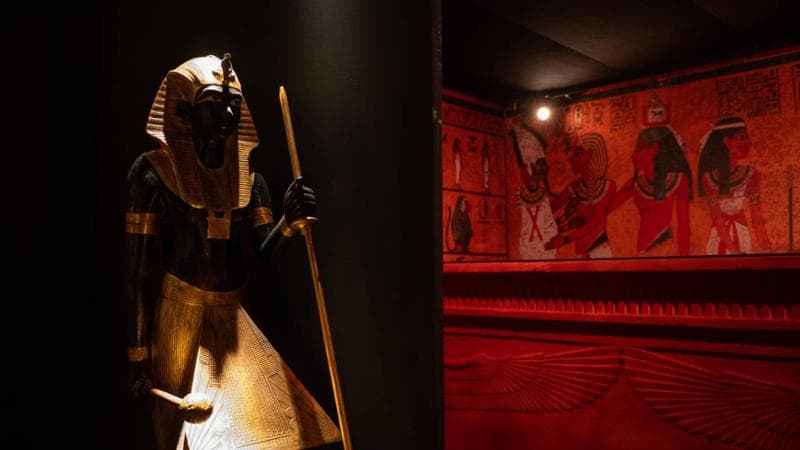
A sense of wonder lies at the heart of the exhibition, underpinned by rigorous scientific standards: around one hundred replicas of archaeological finds have been certified by Egypt’s Ministry of Antiquities in Cairo.
The journey begins with a monumental statue, more than two metres tall, of the goddess Selket, which greets visitors and introduces the story of Tutankhamun.
From Akhenaten to Howard Carter
The exhibition then moves on to a section devoted to the pharaoh’s ancestors: his great-grandparents and grandparents, his father Akhenaten and Akhenaten’s wife Nefertiti. Visitors then come across an imposing six-metre-long wall illustrating Akhenaten’s power and fame.
They also meet an avatar of Howard Carter, the celebrated British archaeologist who discovered Tutankhamun’s tomb in the Valley of the Kings in 1922. The avatar recounts the story of his extraordinary discovery.
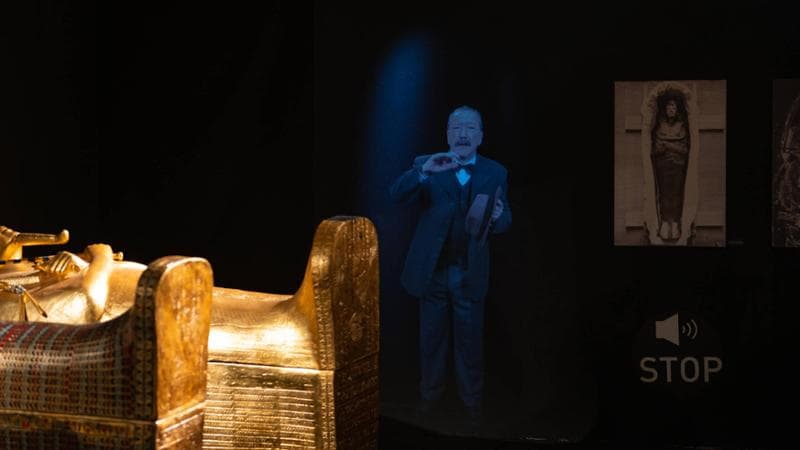
That historic moment is also documented through photographs taken at the time by Harry Burton, the official photographer of the excavation.
Inside the tomb in virtual reality
The highlight is the chance to enter the tomb — virtually, of course. Wearing a virtual-reality headset, visitors can experience for themselves what Carter saw when he first stepped inside its chambers.
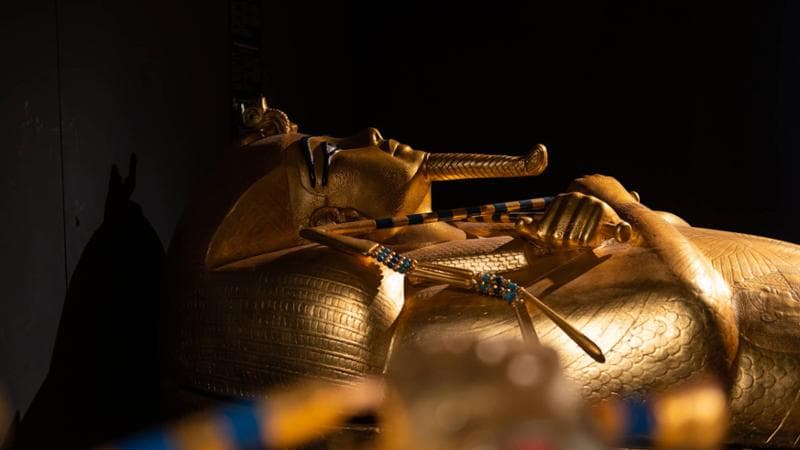
The journey continues with physical replicas of the objects found inside: the ceremonial chariot, the throne and funerary beds, as well as games, chests, caskets and walking sticks.
A large statue of the ka then leads visitors into the burial chamber, with its painted walls and the pink quartzite sarcophagus at its centre.
The meteorite-iron dagger
The funerary objects also include an unusual curiosity: a replica of a dagger made from “meteoritic iron” that belonged to Amenhotep III, Tutankhamun’s grandfather.
The experience concludes with an exploration of the mummification and embalming techniques used in Ancient Egypt.
The exhibition runs until 2 May 2027, and is open daily from 10am to 7pm. Standard tickets cost €16
This article was reviewed by an external translation partner