What artificial intelligence is revealing about ancient Pompeii
Antonio Ferrara
From reconstructing the AD 79 eruption to immersive experiences for visitors, technology is bringing archaeology and innovation together
3 min read
POMPEII – Artificial intelligence and archaeology are coming together in two new projects at Pompeii, one of the ancient world's most iconic sites. The first aims to reconstruct, in a way that is "clear and accessible", the events surrounding the eruption of Mount Vesuvius in AD 79 and the tragic final moments of two of its many victims. According to the most widely accepted estimates, at least 2,000 people died in the catastrophe, out of a population of 20,000.
The second allows visitors to the archaeological site to step virtually inside ancient buildings and experience them as they were 2,000 years ago.
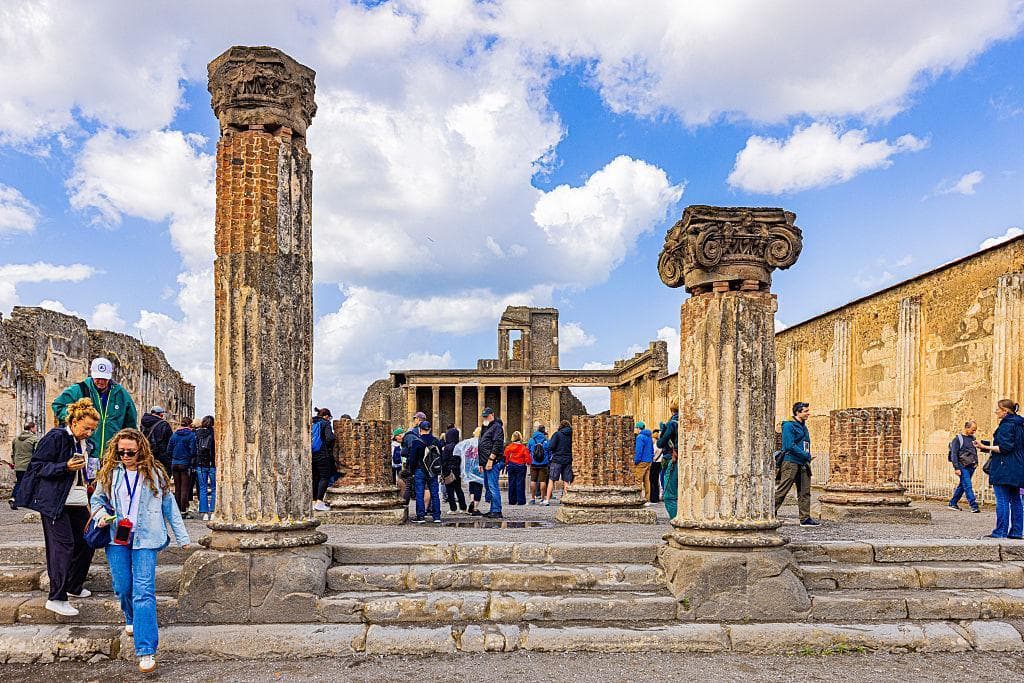
Tourists at Pompeii, where artificial intelligence could transform the way visitors explore the ancient ruins
The desperate attempts to escape Vesuvius
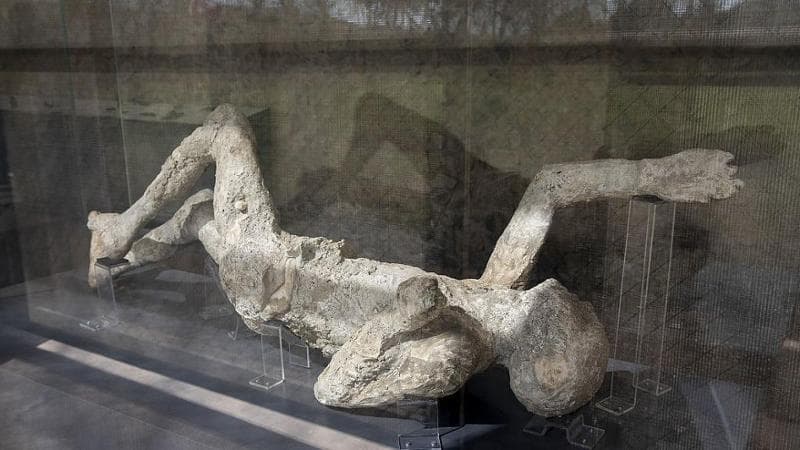
The discovery of the remains of two men who died during the eruption of Vesuvius in AD 79, unearthed during excavations at the Stabian Gate, has made it possible to use AI to generate an image of a man aged around 35 fleeing with the volcano behind him, shielding his head with a mortar and carrying a bag and a small pouch.
By combining physical anthropological and archaeological evidence with volcanological data, a team from the Pompeii Archaeological Park and the University of Padua, whose Digital Cultural Heritage Laboratory is headed by Jacopo Bonetto, has recreated the escape of one of the victims. The man had attempted to protect himself from the rain of ash and lapilli by holding a terracotta mortar over his head.
"If used properly, AI can help revitalise classical studies by presenting the ancient world in a more immersive way," explains Gabriel Zuchtriegel, the 45-year-old director of the Pompeii Archaeological Park. Born in Germany, Zuchtriegel has lived in Italy for many years and became an Italian citizen in 2020.
"Visiting Pompeii or learning Latin is a profound, unique and wonderful experience, and reconstructions help us bring more people into that adventure."
A desperate struggle for survival
The remains of the ancient Pompeian, discovered in April, were found 7.6 metres below the present ground level. His right arm was raised to hold the mortar above his head in a desperate attempt to shield himself from the grey pumice falling during the second phase of the eruption, on the second day, when everything was buried beneath alternating layers of ash and thin deposits of lapilli.
The man was also carrying a ceramic oil lamp, apparently hoping to find his way through the catastrophe that had plunged the sky into darkness.
A second skeleton was discovered at a higher level, 6.7 metres below the present surface. The young man, aged between 18 and 20 and standing 1.66 metres tall, died later than the first victim, as the accumulation of pyroclastic material continued to rise during the eruption.
He was wearing hobnailed footwear and had survived the initial Plinian phase of the eruption, managing to find shelter.
Then, after six in the morning, during a period of relative calm, he ventured outside and headed towards the Stabian Gate, hoping to escape southwards from the city. But a fresh pyroclastic surge extinguished his hopes of survival.
The digital model reconstructing the second victim was created using a combination of artificial intelligence software and photo-editing techniques, with the aim of producing an image that is scientifically grounded yet accessible to everyone.
The reconstruction is an experimental prototype designed to make archaeological research findings more understandable to non-specialist audiences.
Walking through Pompeii as it was 2,000 years ago
From reconstructing the AD 79 eruption to immersive experiences for visitors, technology is bringing archaeology and innovation together
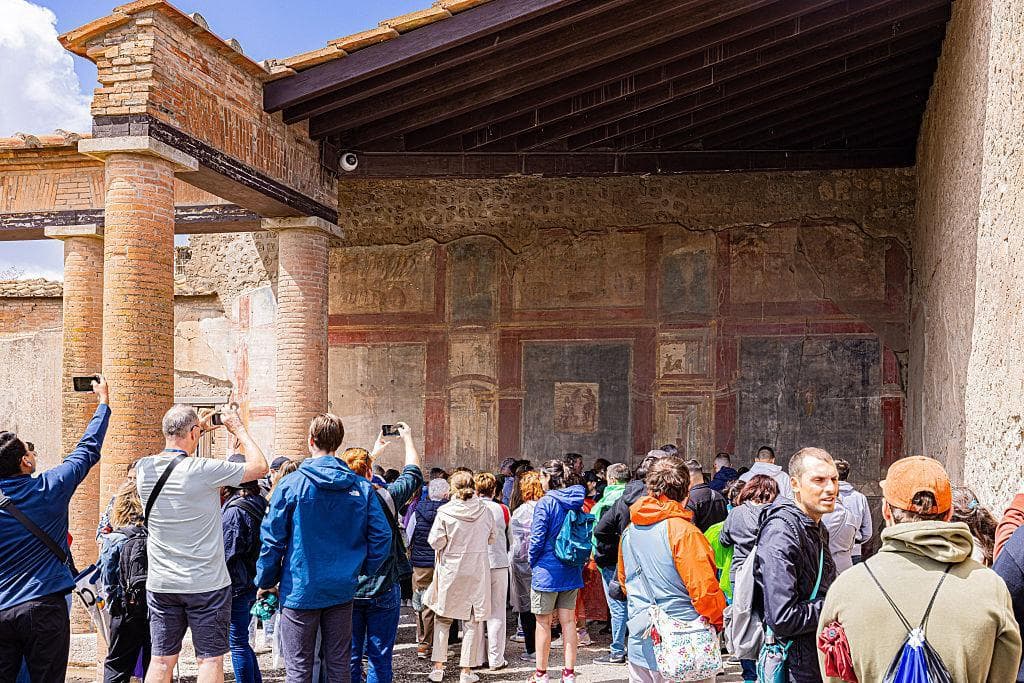
AI tools have also been used to build a model of the House of the Citharist, one of Pompeii's largest residences, providing the scientific foundation for an app now available to visitors.
Thanks to Portyl, visitors can explore the city as it appeared at the time of the eruption of Vesuvius in AD 79.
Using an iPhone, Android smartphone or tablet, augmented reality offers an experience combining scientific rigour, technological innovation and immersive exploration.
Through detailed, historically accurate digital reconstructions, visitors can freely explore different locations, seeing not only the architecture but also the people, animals and events that once brought these spaces to life.
They can witness gladiatorial contests in the Amphitheatre, performances in the Large Theatre and the Odeon, and even the eruption of Mount Vesuvius itself.
Bringing the ancient city to life
The app uses a GPS-based geofencing system to detect when visitors are physically present within designated areas.
This technology enables the reconstructed environments to be aligned with remarkable precision to the visitor's actual location, creating a seamless experience.
Within seconds, visitors are virtually placed exactly where they are standing, allowing them to look around and see the reconstructed historical surroundings brought back to life.
The promise and risks of AI in archaeology
"The introduction of artificial intelligence and digital technologies marks a crucial turning point. These tools are set to revolutionise the protection, research and public enjoyment of cultural heritage. But this revolution is not neutral," the archaeological park's director adds.
For Zuchtriegel, "everything depends on how we use AI. It is an extraordinary opportunity if it serves to democratise knowledge, making complex material, often difficult to understand, accessible to everyone."
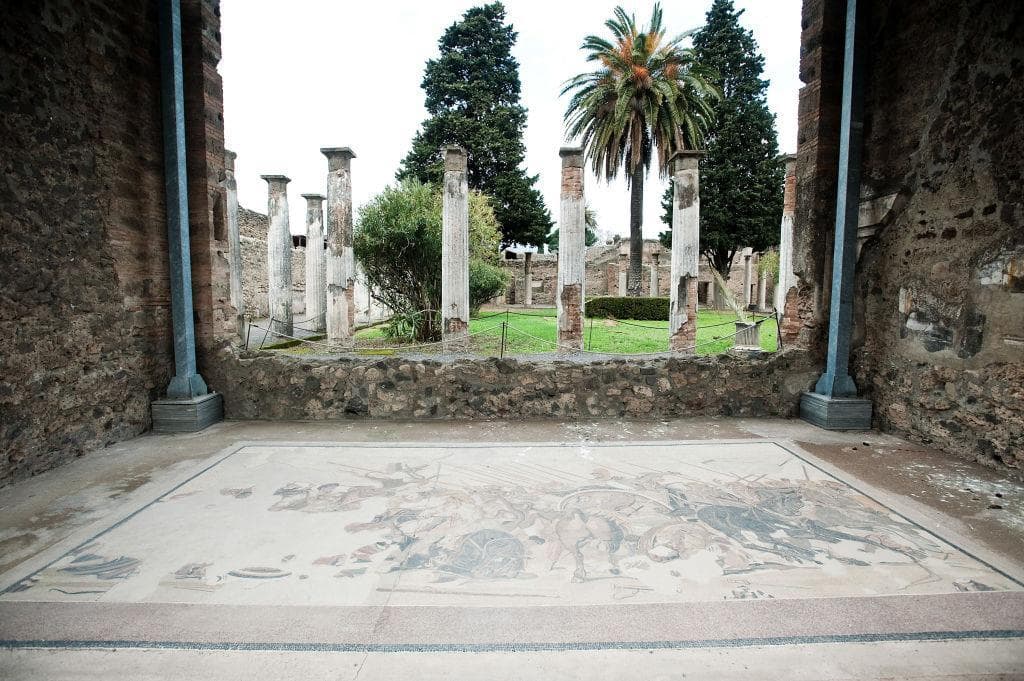
The ruins of the House of the Faun at the archaeological site of Pompeii, Italy
Why archaeologists must remain in control
Yet the German-born Italian archaeologist also sees a danger: "Technology could become trapped in a self-referential cycle, producing content for its own sake, without any real connection to scientific research or authentic cultural heritage."
This, he argues, is precisely where archaeology has a vital role to play.
"Archaeologists must not become passive spectators of machines processing data and producing reconstructions," Zuchtriegel says. "They must take an active role in shaping how cultural heritage is communicated."
This article was reviewed by an external translation partner