
Renewable energy sources are growing at record rates, attracting investment and gaining ground in electricity generation. However, oil, gas and coal continue to meet rising global demand. New technologies are thus being added to traditional sources more quickly than they are able to replace them, whilst decarbonisation risks falling short of international climate targets.
McKinsey’s Global Energy Perspective 2026 analyses this transformation through various economic, technological and geopolitical scenarios. By 2025, global energy demand had risen by 2.7 per cent, and investment in low-emission technologies had exceeded that in fossil fuels for the second consecutive year. Yet coal consumption reached a new record high, gas consumption grew in all major regions, and oil consumption hit its highest level since 2019.
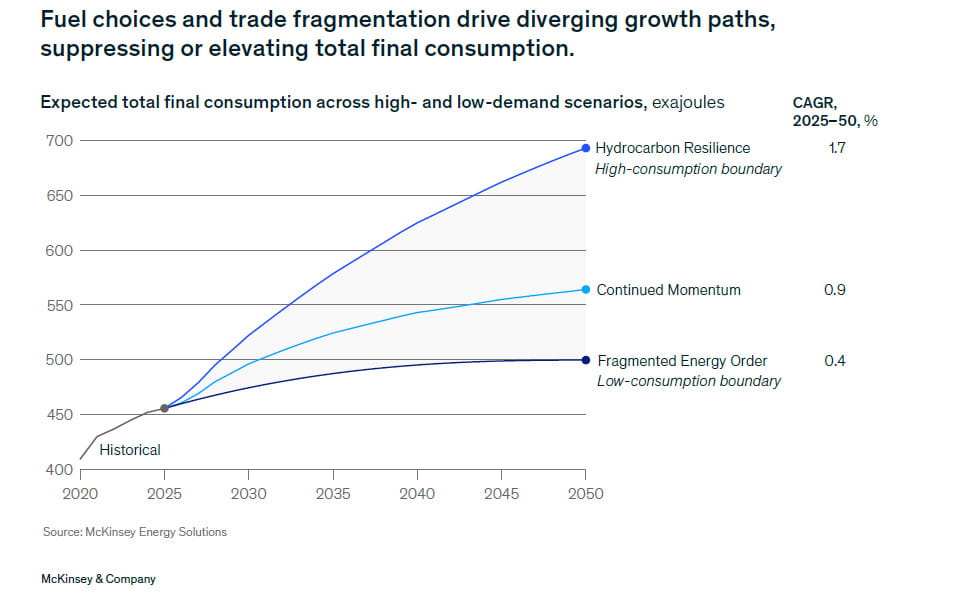
Energy demand is being driven by the expansion of emerging economies, the electrification of consumption and digital technologies. In the ‘Hydrocarbon Resilience’ scenario – characterised by sustained economic growth and a slower reduction in the costs of clean technologies – McKinsey estimates that demand for oil could approach 130 million barrels a day by 2035, 30 per cent higher than today. This is one of several possible trajectories, not the report’s central forecast.
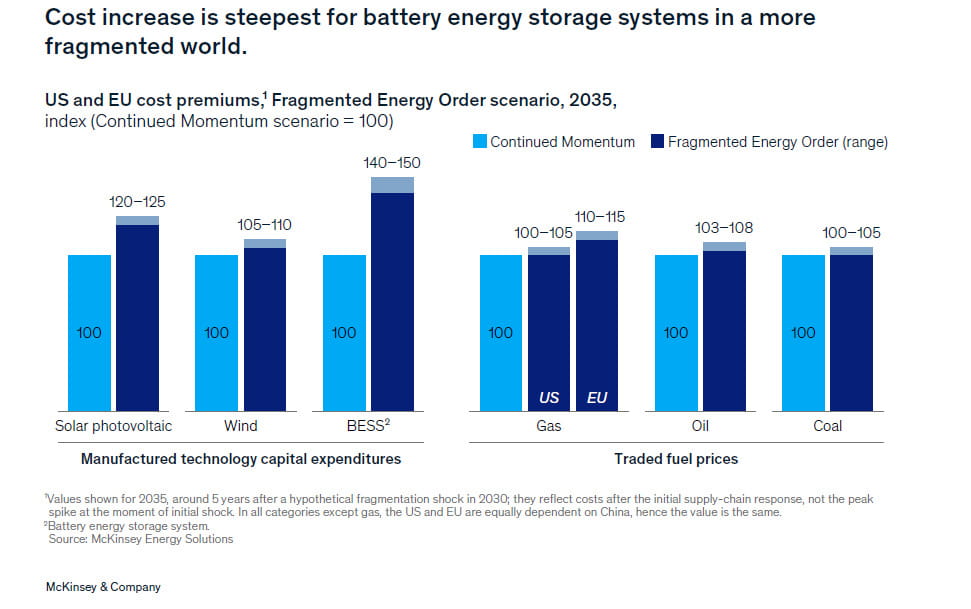
Geopolitics further complicates the picture. The world could split into three major energy blocs, centred on China, the United States and Europe, each striving to strengthen its own industrial supply chains. Rebuilding supply chains outside China could increase investment costs for photovoltaics by 20–25 per cent and for batteries by 40–50 per cent in Europe and the United States. Beijing controls around 80 per cent of global photovoltaic module production and 75 per cent of battery cell production capacity. Dependence on imported fossil fuels thus risks being replaced by dependence on critical technologies and materials.
Another unknown factor is artificial intelligence. In the ‘Continued Momentum’ baseline scenario, electricity demand from data centres would rise by 24 per cent per year until 2030, becoming one of the main drivers of consumption growth in OECD countries. The rate could then slow to 5 per cent per year in the following decade, partly due to improvements in the efficiency of computing systems.
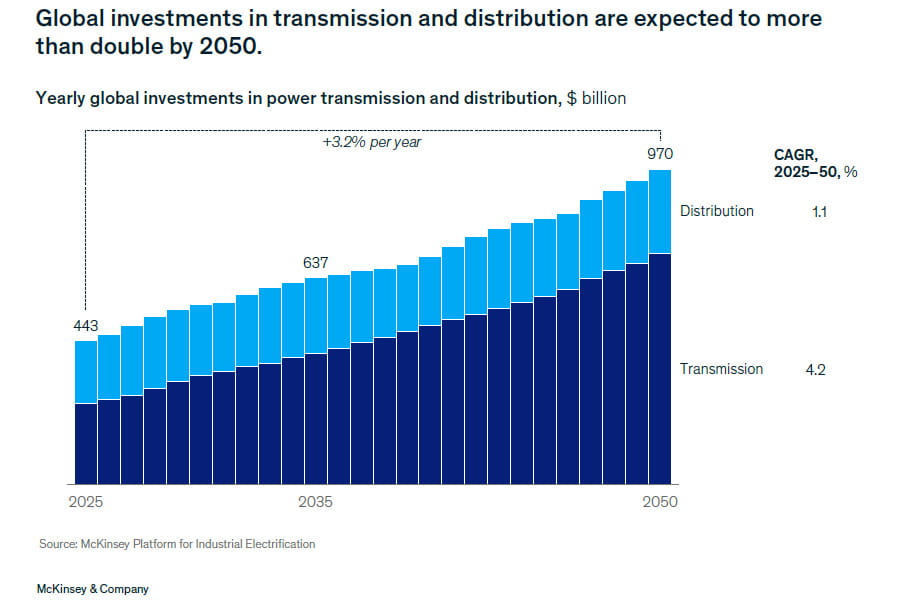
The growth in electricity demand highlights the main bottleneck of the transition: infrastructure. New renewable energy plants are of little use without grids capable of connecting them to consumers, storage systems and generation capacity available when the sun and wind are not producing energy. Global investment in transmission and distribution grids could rise from $443 billion in 2025 to $970 billion annually by 2050, offsetting some of the savings resulting from the fall in the cost of renewables.
In Europe, 50 per cent additional flexibility may be needed by 2030 to align consumption with electricity supply. However, over 70 per cent of households in the EU do not yet have dynamic pricing contracts, which would allow them to use more energy at times when it is cheaper.
Meanwhile, attention is turning back to nuclear power, a source of continuous, low-emission electricity. In the ‘Decarbonisation Delivers’ scenario, characterised by faster technological progress, McKinsey forecasts average net increases in nuclear capacity of 40 gigawatts per year between 2025 and 2050, compared with 18 gigawatts in the baseline scenario. Such expansion is contingent upon reductions in construction costs and times, as well as the industrial development of small modular reactors.
Finally, there remains a gap between current trends and climate targets. Even in the most favourable scenario for decarbonisation, global warming would reach around 2.3 degrees by 2100, compared with the 1.5-degree limit set by the Paris Agreement. The growth in clean technologies would therefore not be enough to offset the rise in consumption. The decisive step will be to transform the expansion of renewables into an actual reduction in the use of fossil fuels.